
+ 1 Rythm vs Goodlabs Real Comparison 45min Apart
I figured some people here might find this interesting, especially anyone who has been curious about how accurate Rythm's capillary blood testing is compared to traditional venous bloodwork.
On November 10, I did a Rythm test and then had blood drawn through GoodLabs approximately 45 minutes later. Both tests were done the same morning, so I thought it would be a good opportunity to compare the results.
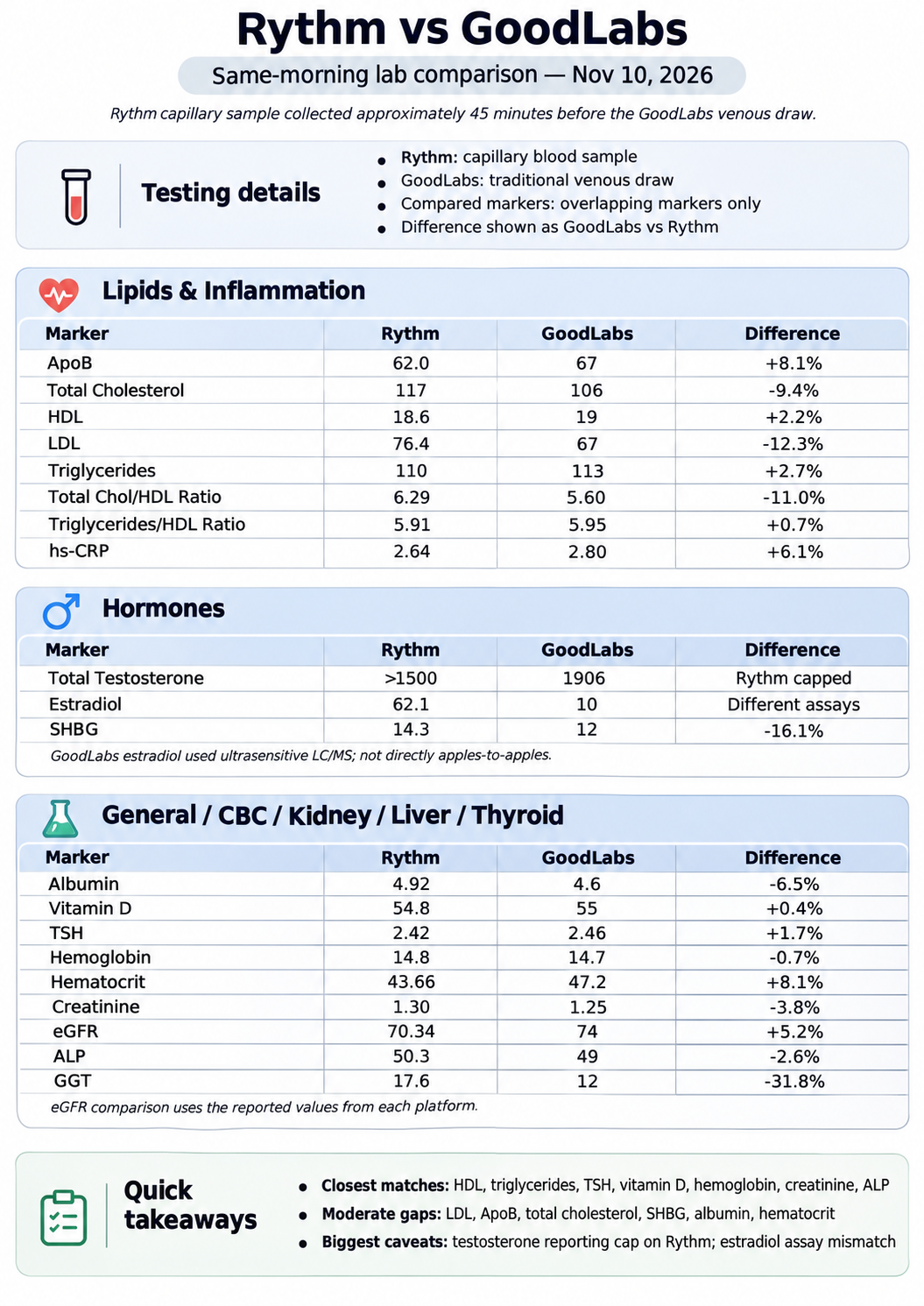
I put together a side-by-side comparison graphic showing all 20 overlapping markers and the percentage differences between the two tests.
The good:
Overall, I was actually pretty impressed with how closely some of the results matched.
HDL, triglycerides, vitamin D, TSH, hemoglobin, creatinine, and ALP were all within roughly 4% of each other. A few were almost identical.
For example:
Vitamin D: 54.8 vs. 55
TSH: 2.42 vs. 2.46
Hemoglobin: 14.8 vs. 14.7
Triglycerides: 110 vs. 113
HDL: 18.6 vs. 19
ApoB: 62 vs. 67
Even ApoB, which is one of the markers I pay particular attention to, was only about 8% different.
Considering that Rythm uses a capillary sample rather than a traditional venous draw, I thought the agreement on quite a few of these markers was encouraging.
The bad:
Not everything matched nearly as well.
LDL was 76.4 on Rythm compared to 67 on GoodLabs, about a 12% difference. Total cholesterol was about 9% different, and SHBG was about 16% different.
GGT had one of the largest percentage differences, coming back at 17.6 on Rythm versus 12 on GoodLabs, although both values were within normal ranges.
Hematocrit was another interesting one. Rythm reported 43.66%, while GoodLabs reported 47.2%. That's a difference of 3.54 percentage points, which is fairly substantial if you're someone who regularly monitors hematocrit.
Hormones were probably the most disappointing part of the comparison.
Rythm reported my total testosterone as >1500 ng/dL, while GoodLabs measured it at 1,906 ng/dL. Obviously, Rythm recognized that it was elevated, but the reporting limit makes it much less useful for someone trying to track actual testosterone levels above 1,500.
Estradiol was an even bigger discrepancy. Rythm reported 62.1 pg/mL, while GoodLabs reported 10 pg/mL using an ultrasensitive LC/MS assay.
To be fair, these aren't necessarily equivalent testing methods, so I'm not treating that as a straightforward accuracy comparison. However, it's still a pretty significant difference in the results someone would see on their reports.
My overall impression:
I think Rythm did surprisingly well on quite a few markers, particularly the lipid panel and several of the general health markers. There were enough close results that I wouldn't dismiss capillary testing outright.
At the same time, there were some meaningful discrepancies, and the testosterone reporting limit is a drawback for anyone running supraphysiological testosterone levels.
I also wouldn't assume that because certain markers matched closely, all of their other markers are equally reliable.
This is obviously just a comparison of two samples from one person on one morning. It doesn't establish the accuracy of either testing method, but I thought it was an interesting real-world comparison given how close together the samples were collected.
I've attached the graphic with all the overlapping markers so everyone can see the actual numbers rather than just my observations.
Curious if anyone else has done a similar comparison between Rythm and traditional venous labs, especially for hormone testing.
- Bookmark
- 1
- 0
Interesting report, thanks for this post brother. I've been a huge advocate to stay away from Rythm at all costs, but this is very close so now its hard to keep talking shit lol. Maybe Rythm isn't so bad, but I'll still stick to good ole Goodlabs.
+1