
posted Wed, 09/16/2026 - 17:14
59
+ 1 Lipids under control
ad
Alright so here’s my last 3 bloods. July I was running a trt dose of 180mg weekly I was fucking around with superlean pwo few times a week which I approved to the higher ldl I ended up proceeding with my cycle and ran 400 test 200npp 200 mast 200 primo and was running mtren 3 times a week and superlean twice a week that really took my lipids to shit so I dropped them but upped my doses to 550 test 450 npp 300 mast 300 primo and added daily 10mg eze 10mg rosu and 20mg Cardarine and man I couldn’t be any happier with my results not only do I feel amazing my lipids are back into reasonable ranges. I’ll definitely be implementing Cardarine in all my blasts going forward and see how just that does for my lipids but man what a good feeling.
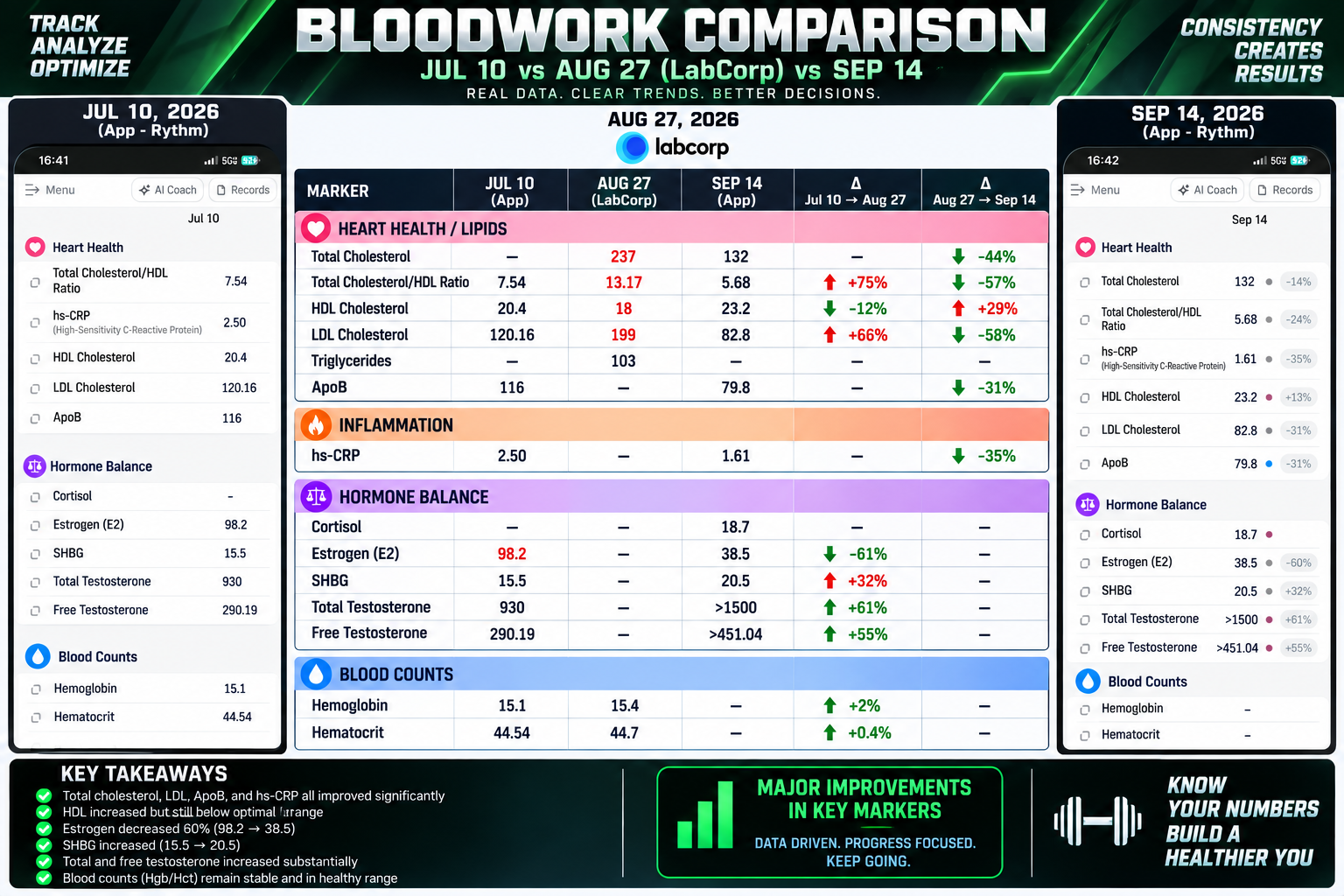
Ordered from:
- Bookmark
- 1
- 0
Cardarine scares me, your not worried about it?
Not at all the dosages that they were giving the mice that caused cancer was 10mg/kg daily so a 200lb person would have to take about 900mg daily I will never get anywhere close to that. 20mg has done exactly what I needed it to do
That math is completely off because you cannot directly multiply animal milligrams per kilogram by human body weight. Pharmacology uses allometric scaling based on metabolic rate and body surface area to calculate the Human Equivalent Dose. Using standard FDA conversion ratios, 10mg/kg in mice translates to roughly 73mg for a 200 lb human, and the actual GSK trials showed systemic malignancies in rats starting at just 3mg/kg, which is only about 43mg in humans. Most importantly, clinical pharmacokinetic data proved that circulating blood exposure at a standard 20mg human dose is only two to three times lower than the plasma levels that caused widespread multi organ tumors in the rodent trials.
I did not write all that above, I am not that much of a egg head to be able to come up with all that on my own lol. I asked AI about this topic about the ratios between rodents and humans based on the trials done, and why the drug was discontinued. You're my bro, so I just don't wanna see anything bad happen is all. I'm just trying to look out for yah.
There’s also this
“ The often-cited 2010 mouse gastric-cancer experiment deliberately gave mice DMBA, a chemical carcinogen, before GW501516. In that experiment, GW501516 + DMBA produced rapid gastric tumors, while GW501516 alone did not produce tumors during that relatively short experiment. So that particular study primarily demonstrates tumor promotion after carcinogen exposure, not that Cardarine independently initiated cancer. ”
Yeah but that was a completely different trial that was separate from the GSK trial. The GSK trail was done with multiple rodent groups using different dosing of Cardarine without DMBA, they still developed spontaneous multi organ malignancies across all dose groups.
The lowest dosage was 3mg/kg in female rats which is the equivalent to 44mg a day but there aren’t any human studies so all of this can be completely useless as our metabolism and digestive systems are a lot more complex and there wasn’t any studies done on what the standard human dose schedule is. But I can see your concerns
If there is even a low chance of cancer I wouldn’t take it. I just don’t think the risk is worth the gains you could get from it. You can take Reta, Clen, T3 and many other compounds that aid in losing weight that are all proven to be highly effective, and no possibility known of them being cancerous. Now I guess the Reta at the current moment is still questionable.
Also didn't they give them the super high doses for something like the equivalent of 2 human years straight?
No the trial took place for a total of two years before they trashed the compound due to every dose from low to high was cancerous.
I just looked into those GSK studies in more detail using AI. I totally understand why you would not want to take it, and I agree that the cancer concern is legitimate. I just think that description goes further than the published information supports.
The studies lasted 104 weeks, but only short conference abstracts were released, not the complete studies. The abstracts say there were treatment-related tumor findings at every tested dose. That does not mean every animal developed cancer. We do not know what percentage of the animals developed tumors or when during those two years they appeared.
For a 200-pound human, the lowest female-rat dose works out to a rough human equivalent of about 44 mg per day, while the lowest male-rat and mouse doses work out to about 74 mg per day. They received those doses every day for essentially their entire adult lives. As a rough comparison, that would be more like a human taking Cardarine continuously for decades, from early adulthood into their 60s or 70s. That is quite different from someone using 10 mg per day for several weeks.
I am not saying that makes Cardarine safe. We simply do not have enough information to quantify the risk of short-term, lower-dose human use. I completely understand deciding that the unknown cancer risk alone makes it not worth taking, though.
But the lowest dose used was equivalent to 44mg so if it’s been found to be effective at 20mg in humans why not see what 1.5mg/kg does for rats
I’m guess they didn’t go lower cause it wasn’t worth the extra research, time, and money invested to see. It’s a very hard sell for anyone when you tell them it’s cancerous, regardless of dose or not.
But yet it’s been proven that ultra processed foods cause cancer and people eat them everyday lol
True can’t argue that lol, same with cigarettes and alcohol.