
+ 50 How do different esters work together?
Most of us know by now how esters work and their importance in our cycles. I would like to share my opinion on how different esters work with each other to coalesce into a single stream. Different esters release free testosterone at different rates. This is common knowledge; the question is what happens to that testosterone once released from the ester? It is my intention to illustrate this question in the simplest and most straightforward way possible.
Disclaimer:
I am in no way a medical professional, PhD or pharmaceutical representative. I am an engineer and math is second nature. That being said the following post is my opinion based off of pharmacokinetic equations and theories. I have charted any and all graphs, illustrations and tables using Excel.
Abstract:
This paper is about how different esters combine to create a homogenous stream of testosterone primarily using Sustanon 250 as a basis. I will first illustrate how a basic Testosterone enanthate ester releases a daily amount of free testosterone into the bloodstream. I will then illustrate how this affects our plasma levels and leads into a taper. This will demonstrate how different esters can affect our PCT and the importance of timing to maintain and or keep our gains. Finally I hope to generate questions that will lead to more in-depth considerations on the subject.
How esters work
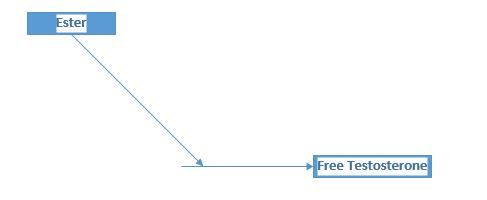
By now I think most of us understand how esters work. Each ester has a specific half-life that cleaves off testosterone into the bloodstream, acetate and propionate being amongst the shortest of the esters. Consequently decanoate, undecanoate and cypionate being the longer esters take more time to release free test into the bloodstream. Starting off with testosterone enanthate we know that the half-life is 8 to 10 days. This means that approximately every 8 to 10 days the original dosage is cut in half (Half Life Math). Now testosterone enanthate has a test base of 70%. This means that for every 100 milligrams of testosterone enanthate there is approximately 70 mg of testosterone. It is therefore surmised that every day 70% of the daily dosage released is freed to attach to receptors. So imagine if you will a large stream flowing through a ravine. Now imagine a tributary connecting to that stream that flows into a larger body of water. The mainstream in this case is the testosterone flowing to the receptors in our bodies and the tributary is the ester releasing free testosterone to flow into the mainstream. See illustration 1.
So for illustrative purposes let’s take a single shot of 100 mg of testosterone enanthate. Knowing what we know about the half-life of this ester at day two we would have 91.7 mg in our body. Now the difference between the 100 mg and 91.7 mg would be 8.3 mg. 70% of that 8.3 mg would be 5.81 mg of free testosterone. (At this point I would like to make it clear that we are dealing with just milligrams for the entire body, the actual plasma level is represented using the nomenclature nanograms per deca-leader or ng/dl). At day three we would have 84.09 mg of enanthate in our system cleaving off the difference between 91.7 and 84.09 multiplied by 70% equaling 5.33 mg of free testosterone and so on and so forth. So you can see that the free testosterone is 70% of the difference between day one, day two, day three and so on. See table 1.
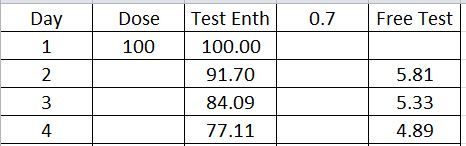
Table 1
If we were to use the table above as an example starting with a 100 mg shot then we would see that over the course of 71 days it would release small amounts of testosterone into the mainstream daily until it reached zero. Graphically it would look like illustration 2.
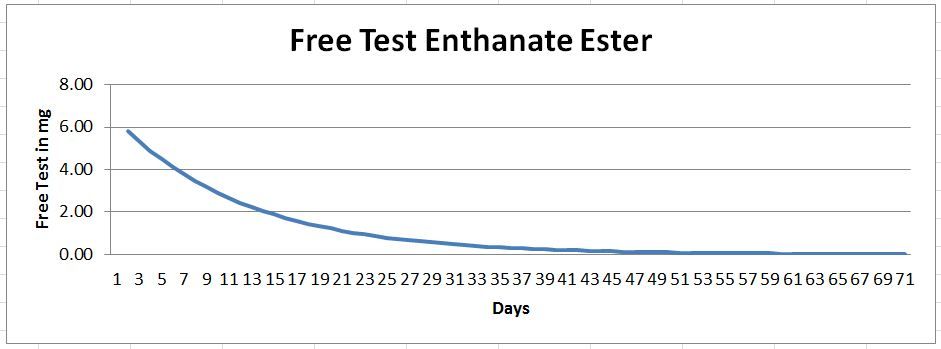
Illustration 2
It is easy to see at this point how the last injection or known amount of testosterone tapers off naturally. This is sort of analogous to a steep cliff wherein one could easily fall down and crash. This is what is meant by a post cycle crash. It is the point where natural production of testosterone cannot ramp up to the previous levels introduced through extraneous injections. This leads into a proper taper at the end of the cycle mitigating the painful loss of gains due to post cycle crashes. This is relevant to our PCT regiments in that if one could calculate the amount of short ester testosterone necessary to gradually reduce or lessen the slope of the curve, we could give our bodies more time to rebound back into a homeostatic state. I will address this point shortly.
Test is test
The heading says it all. Using the theory of a homogeneous stream of testosterone we can expound on the principle that esters work individually to contribute to that very stream. What I’m saying here is that it doesn’t matter what testosterone blend or ester we use, each blend or ester releases testosterone daily or hourly even at its own rate, but it all goes to the same stream. We will use the classic Sustanon 250 as an example. Starting with Testosterone Propionate at 83% with the half-life of two days all the way to Testosterone Decoanate at 63% with a half-life of 15 days, we will see how each ester individually contributes to the mainstream. See table 2.

Using the table above and the previous analogy of a large stream running through a ravine with several different tributaries connecting to it we would get a graphical representation like illustration 3.
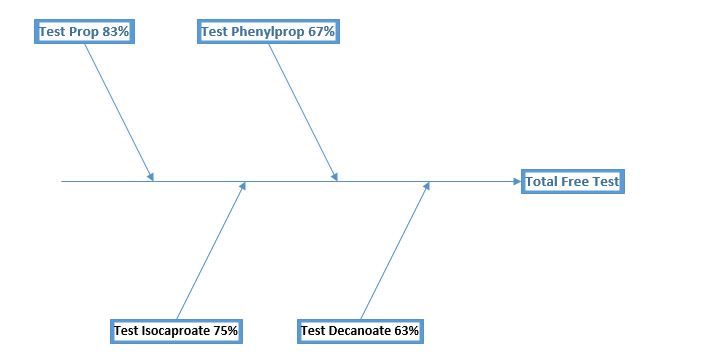
Illustration 3
The mainstream of test is now free to bind to other receptors. What’s important to note here is that each ester releases its own specific amount on an hourly basis until it has diminished itself to zero. So starting with Testosterone Propionate at 30 mg would take approximately 24 days to reach zero and Testosterone Phenylpropionate at 60 mg would take 44 days to reach zero followed by Testosterone Isocaproate at 60 mg would take 87 days to reach zero and finally Testosterone Decanoate at 100 mg would take a whopping 140 days to reach zero. See illustration 4.
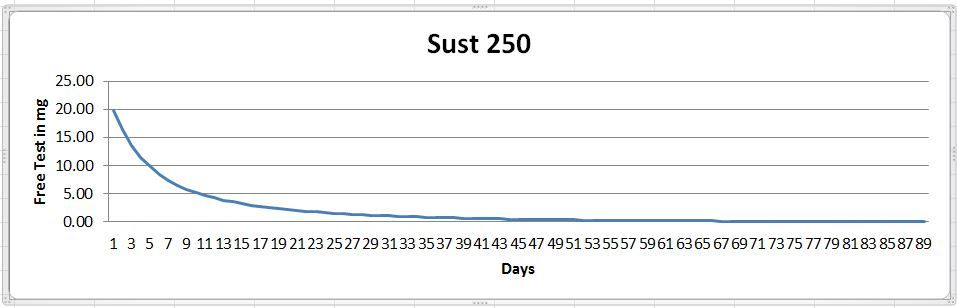
Illustration 4 (In this graph at 90 days the amount is actually .05 mg of test, it actually takes 140 days to reach zero)
Notice how steep the slope is with only one shot this explains why intervals are spaced so closely together when running a Sustanon cycle. However, this begs the question; how much test needs to be in our system to shut down natural production? This would be a huge factor in when we start PCT.
Putting it all together
So knowing that esters release testosterone at an individual rate let’s see what a simple Testosterone enanthate cycle would look like at roughly 1000 a week for 10 weeks with a two-week Propionate taper. See illustration 5
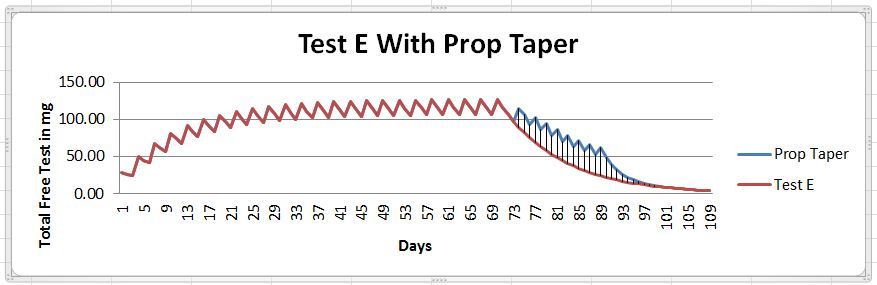
Illustration 5
Keep in mind these graphs represent the actual testosterone in the blood and not the ester. I make this point so as not to get confused with my previous graphs on other papers.
In this illustration I’m showing a Test E cycle of 12 weeks. However, I have stopped the enanthate ester at 10 weeks. This is where it gets interesting if I were to immediately on the last day of the 10th week inject propionate to start my taper, I would see a noticeable spike above the 150 range. This is not really beneficial to us and in fact is extra shots and money. It is better in this case to start the propionate taper five days after the last enanthate shot. By using the propionate to taper we can see how much we can lessen the slope after cessation of a simple cycle which gives our bodies ample time for PCT to kick in.
I know this is way more in depth then most people on here want to get and you do not need to be able to do the math to understand these simple principles, however, by understanding how esters work together you may be able to build smarter and more efficient cycles and that's what it's all about. Right? Thank you for reading.
Other posts I have written that may help you understand the science behind this paper:
Half Life Math
Maximizing Cycles
C.H.
- Bookmark
- 50
- 0
No. The hormone is inactive while still attached to the ester.
Hmm.. So why the extra water weight with sust compared to prop?
How often do you inject sust? if you do eod you should notice zero bloat.
E3d or twice weekly..
" A small portion of an esterified anabolic steroid’s rate of release has also to do with the solubility in fats that the ester itself causes, although this is not as significant of an influence on half-lives as the process of enzymatic breakdown of the ester itself. Esters are, for the most part, long-chain hydrocarbons which classifies them as fats, making them lipophilic (fat soluble), and thereby making whatever compound they are chemically bound to also lipophilic (in this case, Testosterone). Being that Testosterone and all anabolic steroids are already forms of lipids (fats), the addition of an ester will increase the hormone’s solubility in oil and fats. Following an injection, the oil that contains the hormone will form what is called a depot (deposit) within the muscle tissue, and the hormone will slowly move away from the oil to which it is lipophilic, and into circulation in the bloodstream. It stands to reason then that the longer the hydrocarbon chain of the ester in question, the more fat soluble a hormone will be, and therefore this will contribute to the extended release of the hormone. This is the reason as to why anabolic steroids with an extremely long ester chain, such as Deca-Durabolin (Nandrolone Decanoate) hold such a long half-life and are known to even remain in fatty tissues in the body for months after administration has ceased."
"Clinical studies have demonstrated that a higher body fat percentage will present a higher risk of Estrogenic side effects[2]. This is because the aromatase enzyme is highly abundant in adipose tissue (fat), and so it stands to reason that the higher an individual’s body fat percentage is, the greater the rate of aromatization of androgens into Estrogen will result."
Food for thought?
Maybe the answer to the reason why sust causes bloat is due to the fact its longer estered undecanoate has a MUCH higher chance of being stored deep within fat cells requiring it to pass through an entourage of aromatase enzymes hence the higher estrogen conversion?
I don't get extra bloat with sust. I notice the exact same amount of bloat from prop as sustanon.
Maybe my low bodyfat% has something to do with it and I use arimidex instead of aromasin/ Adex is better for bloat control.
This is one of the best write ups ive seen in a while cry_havoc! Great effort bro! Im also very keen on approaching problems and ideas from a mathematic viewpoint and this here write up has left me thinking.... In physics half life decay is merely only a guideline.. There really is no exact halflife of any element even the most basic of compounds must first be.. How can i put it 'exposed' to certain variables before it commences to decay.. Or in our case 'release' when i first started learning about hormone compounds halflifes such as 'testosterone enanthate' i always imagined the slower releasing esters to look something like a '10 petalled daisy' and the shorter ones such as prop to look like a '3 petalled daisy'... Where the actual hormone was released 1 part at a time... In other words i figured enanthate would be an ester with 10 lots of testosterone hormone attached to 1 ester and prop to be more like 3 hormones attached to 1 ester.. I mean mathematically it made sense?! Then when i found out the exact opposite was true ive been almost dumfounded as to how each single individual ester could release hormone at a rate steady enough to have a halflife that was anywhere near predictable...
Lets pretend esters look something similar as below..
Test Undec
[x]\/\/\/\/\/\/\/\/\/\/\/\/\/\/\/\/
Test E
[x]\/\/\/\/\/\/\/\/\/\/
Test P
[x]\/\/\/\/
We have the hormone on the left attached to the ester on the right..
Now lets think of it mathematically
Lets say we inject 100mg of Test E
Lets pretend there are 100 individual esters each with their own hormone attached just wtg to be released.. (Ive no idea what variables encourage the ester to release the hormone pls fill me in if u know, i suspect its just blood flow but no idea..)
So lets say we have 100 esters all waiting in a uniform manner all wtg to be released.. Obviously theyre not all lined up wtg in turn like a line at welfare! Each ester releases 1 hormone 1 at a time and supposedly at a rate we can predict as halflifes but... If we had say 100 enanthate esters with a halflife of 7 days... How could we assume that half of thise esters have released their hormone 7 days in..? Theyre not released one by one and whatever variable effected the first ester to release its hormone should in theory effect the other 99 in the same amount of time in the same manner!? Do the longer esters such as undecanoate hold the hormone much 'tighter'? Or do the esters effect 'eachother' kind of like free radicals? Like.. The first ester releases and then a free ester runs into a bound ester.. Its like hey mofo ima use my positively charged carbon atom to effect ur carbon chain and u can release that there hormone, then theres 2 free esters.. Then they each effect another ester and so on?! (Lmao im prob confusin u all here but bear with me) i understand the esters almost get 'caught up' within the muscle fibre but are they free to roam within the muscle?!?
I guess the debate im trying to raise here is.. What are the greatest variables that effect an esters rate of release and how are longer esters able to hold onto the hormone for a longer period of time? Do the esters themselves slowly decay one carbon chain at a time until finally the hormone is freed? And when i think of esters in a uniform manner.. I just cant imagine how they could be released in a halflife type timeframe... I love ur write up +1 but im stumped on a few things here and pretty keen to learn..
you engineers are all the same! think you're making things "easy" to understand yet i always have to concentrate hard as hell to really grasp and have an understanding of what the hell you're talking about (in my line of work i deal with mechanical engineers) lmfao. seriously though, very informative and well written. i absolutely learned a thing or 2 and had recently been kinda undecided on prop tapers - it seemed a steady decline in levels was preferable than the cliff from prop, but the graphs you incorporated really helped solidify your point and reinforce your writing. very nice my friend, thank you for this and for the time you put into writing it. +1 from me brother
Good choice. I personally think prop taper is pointless. I like the gradual taper and having lower test levels going into pct, also estrogen levels will be lower too without prop taper.
Wow. Thanks. I learned a lot! I never quite understood the differences before. Cool.
I fucking love posts by CH, always in usable form. Plus i love pictures. Tends to keep my attention longer. Read the whole thing and now i understand esters just a little bit better. Also math makes me horny.
X2 lmao ;( is it weird that math inspires a rampant fapping or 2!?
HA! Whats up fucker? I was wondering where you went!
You could say ive been laying low for a while ;p ive had work and other various commitments i had to sort out lol...
You couldn't post this on monday? I hate homework on the weekends...
Quick read looks interesting, can't wait to digest the numbers and graphs.
My bad bro!! I will remember that for next time. LOL
waltrinteresting, good read.
You wrote this and came up with the illustrations?
check out the one he did about what happens when you miss a shot day, and its got some stuff about frontloading. interesting.
Yes. It is all original and my work alone.
Damn bro! Hell of a post!
Thanks Nitti! I enjoyed writing it