
posted Fri, 07/04/2014 - 06:57
35791
+ 16 Steriod Purity Assesment by Electrospray Ionization mass spectrometry
ad
Another write up by the Dr about how the machine that he uses is used for purity assessment.
MODERATOR LOCKDOWN UNTIL FURTHER NOTICE!


Ordered from:
- Bookmark
- 16
- 0
AnonPm sent
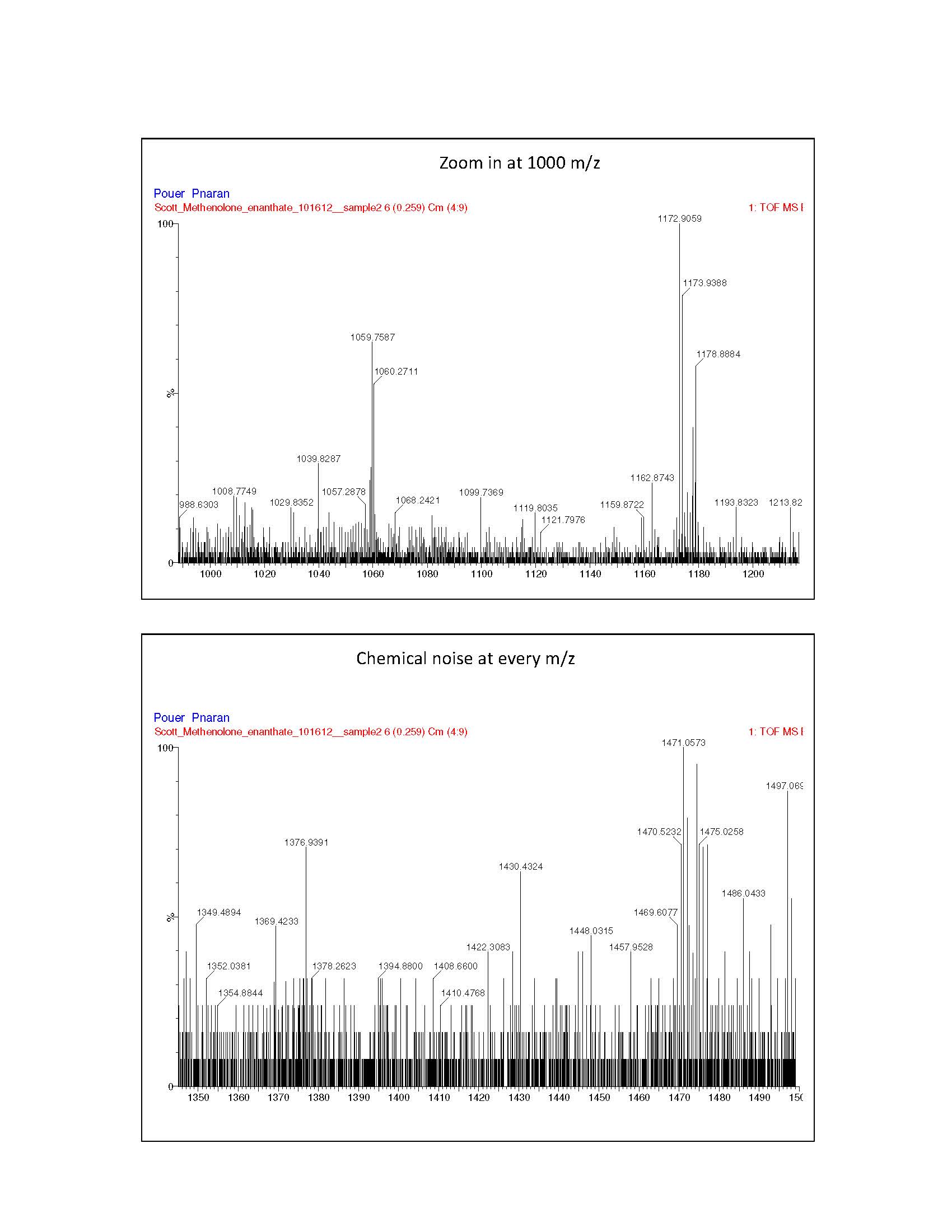
TOF is Time of flight mass spec, not esi.. an if you look at the upper right hand of the attached pics you will see TOF..and what whoever wrote this stated in the pictures above.. is accurate as far as the data I see. If reference standards are being used then the tests are accurate. There are many types of mass spec detectors, EI, CI, Time of Flight(TOF), MALDI, I did take the time to read exactly what this whole debate is about... and i will stay out of that. It appears someone got results they didn't expect.
If reference standards are not being used, what would you guess the margin of error to be?
If you could assume that the gcms sees everything in the sample..and you know what the impurities are..then it would give you a percent purity probably +/-1% but this depends on the EI source and how the instrument is tuned..(autotune, standard spectra tune, etc)..The problem is it is an unknown purity and you cant compare apples to oranges..and remember..its a percent purity of the peaks it sees..not necessarily whats in the sample..for example. .what if some unknown in your sample is too heavy..or too light or its boiling point is higher than your gc is programmed for the run.?.the instrument would never even know see it..Now can you see why i cant answer your question accurately?..hope this helps okay
To state anything with certainty in analytics one should perform exhaustive head-tail analyses according to pharmacopoeia
Quality control or is completely or not at all. Do not encourage anyone to confuse people with incomplete or erroneous analyzes, interpreted by wannabe analyst in the way he wants because this is a crime.
I will say this one more time. If you have a sample
of unknown purity/concentration with no calibrated standard you can only estimate the percent purity of the PEAKS and ions that are detected..you will see impurities as long as they dont have the same molecular weight and elute from the column at the same time as the target analyte..(Coelute).(.I use ANSI deconvultion software to ,..which is free download from NIST..,
to help resolve these peaks..if your sample happens to have impurities that are at same retention times..these ions are mixed in basically with the target analyte peaks..IF you know what the impurities are..those spectra can be subtracted , integrated and then you get a more accurate percent purity...if the impurities come out different retention times then you can estimate how pure the sample is..but not a by weight percentage of the sample you weighed and injected. So how accurate is it with no calibrated standard..honestly i cant answer that because there are too many variables.but you can at least compare the target peaks to other peaks..someone skilled at interpreting the results is needed because the software only gets you so far. .I have developed formulas from gcms runs that contained more than 30 different unknown compounds based on just a percent report. its a close copy..i have all the ingredients just not accurate by weight percentages. .A standard of the target compound is needed..or at least one that gives similar peak responses across a range of concentrations will work .DHT might work for example..Anyway ..all of this information is out there. I dont mind sharing what I know and my experience. But..ask google..it has more answers than i can provide.. and educate yourselves ..and make informed decisions based on evidence..not opinions..check out quantitative analysis..gcms. There is a wealth of info out there..Be blessed and safe..and learn to work together and stop arguing
The main purpose of quality control is to demonstrate the efficiency and safety of the product. One of the basic tests is the dosage of the active ingredient and the impurities present which can only be compared to the standards of reference for each position. In the first phase we do the quantitative determination of the active substance after which we do the quantitative determination of impurities. Impurities are strictly limited in quantity as they are harmless impurities ( eg inert water ) then are similar pharmacologically related impurities as not dangerous ex. for testosterone enanthate a impurity is testosterone basic solution that is not dangerous but in this case their quantity is strictly regulated. Also exist another class of pharmacologically active impurities with certain health risk to consumers ( like acid heptanoic in test ena ) - that is why the analysis should be performed completely and correctly.
*Quality control or is completely or not at all. Do not confuse people ( or back anyone who confuse them ) with incomplete or erroneous analyzes, interpreted by wannabe analyst in the way he wants because this is a crime
angusAmen brother.
Thanks for repeating that, in layman's terms. I've got to learn a lot more before I can even start arguing.
This has been fascinating stuff, even if most of it is over my head, I will google as you suggested.
hey check this out. this is the same methodology I based my company's SOP on..
http://www.epa.gov/fem/pdfs/calibration-guide-ref-final-oct2010.pdf
No problem..believe me it took me about a year of running gcms to get the handle of it..I still use outside resources for support..I am not an expert on interpreting the results .I did have to build a quanitation library of more than 600 raw materials which took almost a year....I think its great that samples are being tested..and honestly i have used the same method that i see angus posted for personal info..and for a friend or so here and there and i trust the results with some degree of confidence.....peace brothers!
Can you confirm that without standard the quantitative result for concentration and for impurities is so relative that a real analyst will avoid to write on any official paper a quantitative result done on MS without standards ( both for API and impurities ) ?
Without reference standard can you confirm that the margin of error can be 50% or more ? Can you give any number ?
Great things happening here. I love how the fanboys have nothing to say when there is an intelligent debate going on.
Couple questions for Labrat.
If the lab that is doing mass specs for Angus has calibrated standards of a known purity. does that make the results for concentration accurate?
Does this mean we should not consider the purity percent valid, as tested by the lab Angus uses?
Thanks for chiming in with some great info.
If they have quantified standards , then yes.
68QSo with out a quantified standard is there a test or a group of test that can be ran to have the exact purity?
So you confirm once again everything I have stated until now. ONLY with standards you can determine the concentration of the product and the concentration of purity.
Thank you for staying real.
Can you confirm that without standard the quantitative result for concentration and for impurities is so relative that a real analyst will avoid to write on any official paper a quantitative result done on MS without standards ( both for API and impurities ) ?
It is so relative that can give you a error by 50% or more. Please contact any certified laboratory and ask them if they would do such a analyses after Angus method or if they would consider Angus method valid. Any serious lab will put in trash that result
It is an estimate..the mass spec will detect whatever impurites are volatile , and come put of the column and that fragment into charged species when the electron smashes them..Look, this method is far better than no method and without calibrated reference standards, that you cant even purchase without an FDA drug license..it is the exact same thing I would do..it WILL ID the compound and give an estimated percent purity..so please do not discount the results, they are as accurate as they can be with the method being employed..DO NOT stop testing.
In the morning your post was very correct and was describing the methods exactly like from the book. It was good. Please keep that honest way.
In this post you are half right ( in first post you were totally right ) Angus can do the identification based on the library you are right. But fo the estimation of the purity error WITHOUT REFERENCE STANDARDS please mention how much that error can be exactly ( because we talk about analytics NOT STATISTIC).
Is that right can be 50 % or more ?
Also I asked you earlier, just because I was suspicious about a new chemist appearing suddenly,
( Maybe I am just paranoid and you were here since 2012 reading MS tests without doing any comments but you decided only now to talk. Sure anything is possible.) IF YOU DO NOT MIND please check this link where Angus posted some scans
http://www.eroids.com/pics/estimation-of-steroids-concentration-by-mass-...
There are some serious errors that professor mentioned and I posted there. What are you comments ? Please do those comments there not in this thread to keep things clear.
Also documents posted here in this thread have several errors. I have not received yet the material from the professor being weekend but maybe you can point us the errors. If not please look over it and confirm everything is correct.
There is lots of suspicions here regarding those MS, do not take me wrong, do not put your fist in my mouth but do not ask me or anyone to stand in knees before you because you posted a correct post in the morning . Please lets put all arguments on the table all materials until people get a clear image of what Angus is doing. Then members will decide if they should spend those money on extra gear or on MS tests.
About reference standards: if he have a license for MS he can buy any standard from what I know but I can recheck. They never ask you additional licenses for each standard but I can recheck also. Also the professor told me he is doing small synthesis for some impurities or API he can not find for sale. So Angus doctor can do the same. They are making money from those tests as I mentioned they are not doing for free so they should invest into keeping testing accurate.
I am behind on this thread, What do you claim Angus is doing? And do you believe it is intentional?
First I very rarely come on eroids and yesterday was actually the first time I saw any ms reports. I am not here to affirm or discredit anyone. The information I am giving is just science and I leave that to anyone who wishes to argue it. I was asked if it made sense to test with this method and again, the answer is yes it is..its better than nothing..it will at least id the compound and what impurities are present, and by comparing the area of those peaks give you a relative percentage...but if you start with a sample of unknown concentration..then no absolutely will not give you an accurate percentage by weight or volume..I will add that it is ridiculous to think you can purchase a standardized reference sample without a drug license .Try this..call Roche pharmaceuticals and tell them you want reference samples of Oxycodone because you are building a quantitation database okay?...aint gonna happen..legally anyway....
Commercially available libraries have the spectrum..but they can be used to compare for qualitatative..not quantitative results.
I was asked if it was worth testing this way..
Yes..better than not at all.
In lieu of obtaining a validated reference sample..what I would do is get validated references of compounds that give similar m/z responses that arent illegal .Hell cholesterol..DHEA, androstendione..all obtainainable and can be used..once they are quantified, you can use to spike in with the unknown sample and thus determine an accurate %.
Look I could care less what you or anyone thinks..Ive had idiots try to argue with me about what the boiling point of water is okay..the great thing about science is, it takes peoples opinions out of the equation.
The reports I see are relative percent reports..there is no need to repeat what ive already stated. I think its better to test with this method than not at all..
Perfect. Allow me to doubt since you pop out suddenly without testing history.You can prove I am wrong sure.
Anything is better than nothing but is not accurate as you agree. And the error margin is unknown so can be like 50% ?
You say very correctly : "IT WILL AT LEAST ID ( IDENTIFICATION ) OF THE COMPOUND AND IMPURITIES "
We have nothing against the use of mass spectrophotometria method for identification. But exactly like you said, FOR QUANTITATIVE DETERMINATION OF THE CONCENTRATION and THE IMPURITIES you will need REFERENCE STANDARDS. Without them the error is UNKNOWN ( could be 50% ? yes could be ).
You are correct sir. Better than nothing but for ID of the compounds.
But even for ID is needed that the guy who handle the MS knows his job and is honest. If I would get from Angus answers like I am getting from you now, my trust in Angus would exist. JUST FYI I could help Angus get some standards from university. I offered him a help at the beginning to correct his tests but he put his fist in my mouth.
Anonlol'ing
angusLOL.
Angus and his YESMAN this is a very cool argument ( LOL ROTFL ) . You convinced me about your incompetence.
Please before you and your guys post more informations please understand that there is no perfect crime and no perfect lie. You are not the only guys who understand ( little) analytics and do not bet that people here are too lazy to understand. You will be surprised
AnonThank you for that! I think those were the kind of layman's terms most of us were waiting for...
Give them a vote if you find it helpful.PermalinkangusThank you for your input, you have no idea how helpful you have been.
Just what we needed to know.
angusValidation is sweet. Thanks for all the leg work CBBurrr! I know you have been pouring over all of this stuff and asking a ton of questions.
Calibrated standards are required for validated % purity. If you dont have calibrated standards, a test mix.,external standard may be used. Basically you load a compound of known purity that gives similar m/z response.and this test mix is spiked in with the compund of an unknown purity and those peak areas are compared. Different compounds give different responses, they arent the same, the size and structure and how that compound fragments into ionized species determines what the m/z response will be. The mass spec. however can only detect charged fragments uncharged pieces are not even detected.
The percent report is basically adding up all the peak areas, of the compound AND whatever impurities the mass spec detects..calls that 100%..and then the target compound peak is just a percent if whatever the total is.. This only accounts for what the mass spec detects..Put simply , it doesnt yield a weight to weight or weight to volume percentage of the sample. So basically the sample size doesnt matter..the mass spec will detect the hopefully mostly pure sample..it will be by far the largest peak, and the impurities will be smaller peaks. .the sum of the areas of those small peaks is added up and compared to the area of the largest and presto you have a relative percent purity.. Does it identify the compound? Yes..does it give you a purity estimate? Yes, but only on the what the mass spec detects. Is using this method worth it? Absolutely..but realze its a relative and not an absolute percentage.. If you have a known pure sample a reference library can be built and used as calibrated standard..
This is not accepted. How you know for sure that compound have the purity you think ?
Excuse me but you say that one small error here, another small error there plus then at the end a RELATIVE purity than without standard can be anything give us a acceptable error ?
Lets be serious. I am sure Angus appreciate your help but you need to keep things real exactly like was your first post which I appreciated.
You purchase a reference standard of known concentration that gives similar response values.You must start with a known quantity. If i have a mixture of 50% compound A, and 50 % compound B , you would think that the peak areas you would see for each would be the same..not so..Compound A may show abundances 5xs higher than compound b...and if you did a percent report it may show 80% A and 20% B even though there is by weight a 50% of each...molecules fragment and respond quite differently..but compounds of similar size, and structure..give similar response values. ..Look up quantitation gcms..there are several ways to quantify..from not very accurate.to.Extremely accurate depending on the type of detector and sensitivity..An FID ,(flame ionization detector) works great and is accurate to +/- 0.1%....there are several methods for quantifying with ms:..%, external standards, internal standards, Single point, multipoint , . The information is available to anyone who wants to learn. Educate yourself
Is this as simple as buying the compound from the pharmacy and using it as you reference standard?
http://www.usp.org/
companies that manufacture the compounds of interest. and the companies that sell the columns. columns used in gc/ms can be specific or for general purpose for the types of compounds being tested.
Sigma Aldrich is one of the big chemical supply companies. but you can go online to chemspider for example..type in the name or CAS number and it will give you a list of suppliers who make that chemical. Then you call and tell them you need standards of that compound for reference library..gcms, ftir, hplc, whatever, and they send three reference standards from different Lot numbers. Controlled substances are restricted of course and if you want validated standards then you will need a federal drug license to obtain these samples "For Research purposes" .. but you won't get these from a pharmacy.. they can be hard to come by
from the USP a certificate looks like this for example.
http://www.usp.org/pdf/EN/referenceStandards/certificates/1646009-J0G360...
If one can not purchase standards to perform a correct analyze then he should not do such a analyze. He should start testing the level o glucose from urine in such situation
Any method that is recognized by pharmacopoeia is good and the main problem remains conducting qualitative and quantitative analysis in compliance with all the rigors and correct interpretation of results
Again and again: quality control or is completely and correctly or not at all. Do not confuse people ( or back anyone who confuse them ) with incomplete or erroneous analyzes, interpreted by wannabe analyst in the way he wants because this is a crime
How relative ? We talk about analytics not statistics. How relative is important. From what professor is telling me they are very strict when talk about analytics.
It is so relative that error can be 50% or more ?
Can you confirm that is so relative that a real analyst will avoid to write on any official paper a quantitative result done on MS without standard ?
Thank you!
Loose_CannonI'm to the point where I don't know what to do believe anymore, I know for damn sure I will never ever let a mass spec hold so much weight around here anymore with all these valid points that have been brought to light
Do not believe anyone ( not even me ) until everything will be cleared. It will take some time because Angus has too much ego to admit he was wrong until now and learn to do analyses then start doing good. ( If he has no standards I can help him believe me or not )
I told him to write a rebuttal on his analyses then start over from scratch doing correctly. Take some guts to admit the truth, but is not the end of the world.
I am an analytical chemist ,at least thats what the masters degree from university of florida says, and I work at an FDA registered pharmaceutical company. We use FTIR, HPLC,, GC/MS, LC/MS, tandem MS/MS, .
Its not complicated really to understand how this works: The gas chromatograph, or liquid chromatograph separates the analyte based on ita molecular weight and boiling point and they elute from the column at given times..retention times..lighter, more volatile come out first, heavier later.. The EI mass spec is basically an electron gun that smashes the compound into fragments, and essentially gives you the molecular weight based on the total ion count and compares it to reference libraries and thus identifies the compound..never 100% but its based on a best hit% Think of the mass spec as an extremely accurate scale . The issue is that not all of these molecular pieces or fragments are necessarily detected..and then there is the issue of compounds coming out or eluting at the same time..if the parent ion a.k.a. molecular ion must be present, otherwise you may have to switch to CI, chemical ionization mass spec...which doesnt smash the molecule into fragments..thats not important to understanding the basics however.
Well absolutely the only way to accurately quantify a compound of unknown purity is to have a reference standard of known purity. Say that reference standard is known to be 99% pure okay?..An aliquot is made of say 1 mg/ml.. that standard is analyzed and the area under the peaks displayed is calculated, as is the total ion count,(TIC)..okay..next you half that and run one at say. .5 mg/ml ..and those peak areas are calculated, . Then .25mg/ml..okay..so then you can plot a 3 point calibration curve.. 5 is better. Now say Joe the kitchen chemist sends you a sample of unknown purity..you prepare a..lets say .5 mg/ml solution...run it..and it is compared to the known standard and an accurate quantity can be determined. based on the area under the curve,..You MUST have calibrated standards and they MUST be of known purity. Otherwise it is all just an estimate..and thus, at least in the regulated pharmaceutical world, invalid. An estimate can be made of an unknown, if you know the impurities, but this is just comparing the area under the peaks, or TIC , of the compound in question to peak areas if whatever else may be in the sample(impurities)
This is a relative percentage and not at all accurate to determine purity with much % confidence. hope this helps
AnonGREAT job putting this explanation in terms we can understand. I'm still not there 100% but this helped tremendously. I would love to see more input from you in the future. Thanks!
Give them a vote if you find it helpful.PermalinkWOW ! Very professional ! Sounds exactly like the things professor explained me. Maybe you can teach Angus how to do tests correctly , using standard for API and standards for impurities like you explained here then he could correct his method and we can resume trust in his analyses.
EDIT. In this pages here I understand from a professor there are some mistakes. He will finish soon his comments on this and I will post. Maybe you can comment on the other pages Angus posted and where a chemist already wrote comments and showed his mistakes : http://www.eroids.com/pics/estimation-of-steroids-concentration-by-mass-... ) With the hope you are impartial, I wait your opinion.
Awesome read!! +2
good read
Thanks labrat! Good read..thanks to angus too
AnonGreat post, bro! Thank you for taking the time to share your insight and experience with us on the subject. We need more of this!
By the way, you've been hiding in here since 2012 with all that info under your hat, huh?? lol
Give them a vote if you find it helpful.PermalinkangusI agree, I think that working together as a team we are way more effective than standing alone.
AnonI believe you, bro. That's the nice thing about us being a community....even with the responsibility you have assumed (maybe thrust upon you would be better stated), there's no one here claiming others shouldn't be involved, including you. I appreciate that. And I think all of this dialouge will eventually spread the responsibility out and an increase in trust and reliability will result. That will be a win/ win for everyone.